Business guide
Starting a Water Refilling Station
Check a site, price a delivery route and find the number of five-gallon refills your station needs to sell each day.
Check your site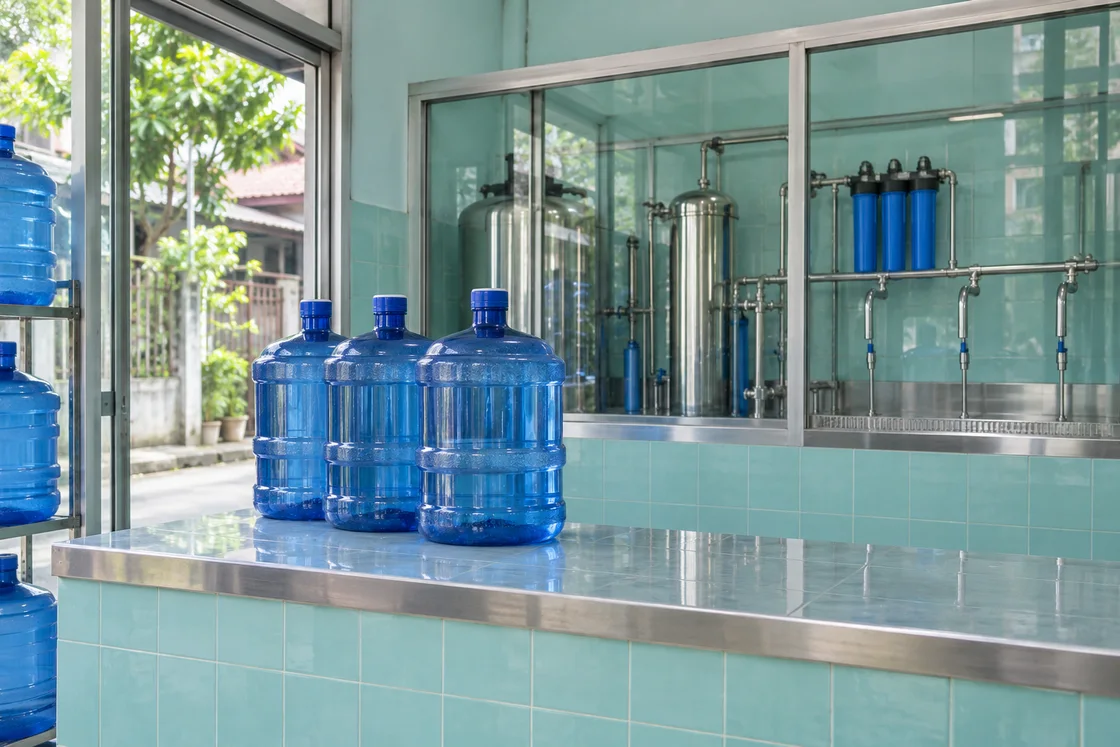
Clear the site and water source before signing a lease
Before paying a deposit, take the address and layout to the city or municipal health office. Check zoning, flood exposure, power and source water. DOH rules specify at least 25 meters from direct sources of pollution. Allow space for washing containers, filling them and storing empty and filled containers separately.
Have a licensed sanitary engineer sign and seal the plans for local health office approval. Obtain the sanitary permit before opening. Ask about the 40-hour operator course, the 20-hour staff sanitation course and recognition of equivalent training. DOH rules for water refilling stations, sections 4 and 9
Water testing before and after opening
Arrange initial and recurring testing through a DOH-accredited laboratory. Table C-4 sets monthly sampling for the listed microbiological parameters and two samples per year for mandatory physical and chemical parameters. Confirm the raw-water and finished-water schedule and any additional local parameters with the health office. Budget for sampling and renewals. Philippine National Standards for Drinking Water, Annex C, Table C-4
Count buyers and test a delivery route
Ask households and businesses how many five-gallon containers they paid for last week, where they bought them and how often they reorder. Separate customers who will collect from those who need delivery.
| Location | Advantage | Drawback | How to test |
|---|---|---|---|
| Apartments and boarding houses | Several households can reorder on one short route. | Stairs and single-container stops can take longer than the drive. | Ask what residents actually buy in a week and what they pay. Time a route including parking, carrying full containers and collecting empties. |
| Subdivisions and condominiums | Scheduled exchanges can group several orders into one visit. | Gate restrictions, delivery windows or an existing supplier can limit access. | Confirm access with the administrator. Count households willing to order on the same delivery day. |
| Offices, eateries and commercial strips | One stop can take several containers at a time. | Buyers may ask for discounts, receipts or credit terms. | Ask for actual weekly volume, delivered price and payment terms. Check where full and empty containers can be exchanged. |
Compare the same service
Agua Vida posts ₱50 for a five-gallon walk-in refill, ₱55 for a one-trip bottle exchange and ₱60 for collection and return of a customer’s own bottle over two trips. Agua Vida Ayala Alabang · refill and exchange prices
Red-Gold in Cebu posts ₱25 for a five-gallon refill. Check the comparable walk-in price and all delivery charges on your proposed route. Red-Gold Cebu · five-gallon refill price
Time a route from loading to the return of the empties. Divide the whole trip cost by the containers actually delivered. Include both journeys for a pickup-and-return service.
Price the full opening budget
The sample starts with the ₱210,000 AJS cash package. The other figures are editable planning examples. Ask for the treatment design for your raw-water test results, daily output at your address, filter and membrane prices, parts availability and warranty.
Compare Philippine equipment quotes
WaterMax lists cash prices of ₱140,000 for Package 1 and ₱180,000 for Package 2, dated 9 November 2026. Ask which site work, delivery and commissioning are included. WaterMax · station packages
AJS lists ₱210,000 cash for a single-membrane package with tanks, installation and training. Its summary says 3,000 gallons per day and its detailed specification says 6,000. Get the finished-water output at your site in writing. AJS · single-membrane package
Supplier listings checked 22 November 2026. Get a dated quote for equipment, tanks, installation and training. Include each cost once.
Allow for drainage and power upgrades, racks, reusable containers, caps and seals. Include delivery equipment if you will offer delivery. Set aside enough working cash for the first bills while orders build.
Find your daily break-even refills
Orders and prices
Enter the total price the customer pays for each refill. Keep refundable container deposits separate from sales. Use a delivery share of 0% for walk-in only or 100% for delivery only.
For production cost, include source water used per saleable refill, electricity, filter and membrane wear, washing and seals. For monthly fixed costs, include rent, staff or owner pay, routine tests and overhead.
Delivery route
Use the actual average load on a trip. Count fuel, trip-based labor and vehicle wear. Include a salaried rider’s pay only once. The example spreads ₱54 over six delivered containers, or ₱9 each.
Treatment and filling capacity
Use measured finished-water liters per hour and the number of containers your team can wash, fill and seal in an hour. Enter usable production hours after downtime. Use your container’s marked volume.
Daily break-even target
33 refills834 refills per month at an average contribution of ₱36 per refill.
- Walk-in margin per refill
- ₱38
- Delivery margin per refill
- ₱34
- Monthly operating profit
- ₱16,800
- Simple payback
- 20.8 months
What the station can serve
- Treatment per day
- 101 refills
- Washing and filling per day
- 96 refills
- Delivery route per day
- 36 refills
Projected monthly sales include 650 walk-in and 650 delivered.
The model rounds the monthly sales mix to whole containers. Walk-ins use available finished water first. Deliveries use the remaining water and available trips. Trip costs use your average containers per trip across the month. Simple payback divides opening cash by positive monthly operating profit, before tax, financing and depreciation.
Worked example · 30 or 50 refills a day
At ₱50 for walk-in, ₱55 delivered, ₱12 to produce a refill and ₱9 extra to deliver it, the margins are ₱38 and ₱34. An even split leaves ₱36 per refill. With ₱30,000 fixed costs and 26 opening days, the target is 33 refills per day.
Under those assumptions and with enough capacity, 30 paid refills a day produce a ₱1,920 monthly operating loss. At 50, monthly operating profit is ₱16,800.